





The Master’s Degree in Economics and Data analysis for Industry and Policy (MEDIP) is a two-year programme entirely taught in English. It is designed for students with a bachelor’s degree (or equivalent qualification), in Economics (preferably) or related fields. MEDIP builds on the Department’s strong research tradition, combining advanced expertise in economics, econometrics, and data analysis with an applied and interdisciplinary approach that bridges macro- and microeconomics, business dynamics, and legal studies.
The first year offers a common pathway designed to provide students with strong quantitative and methodological skills. In the second year, students are asked to choose one of two specialization tracks:
- an "Industry track”, focused on innovation, digital markets, and competition;
- a ”Policy track”, dedicated to evidence-based analysis and evaluation of public policies.
In addition to professional opportunities, the programme also prepares students for further academic studies, facilitating access to doctoral programmes and PhDs at international universities.
It is also possible to explore detailed course contents and teaching assignments through the following link: MEDIP short guide .
Master Coordinator: Professor Cinzia Di Novi (email: cinzia.dinovi@unipv.it)
The Industry track trains professionals to analyse markets and industrial dynamics, with a focus on innovation, digitization, and competition. It is designed for graduates who want to find employment in multinational companies, SMEs, regulatory authorities, research offices, and consulting firms, contributing to strategic decision-making, internationalization processes, and the assessment of the economic impact of business choices.
The Policy track trains policy analysts capable of evaluating the impact of public policies using advanced quantitative methods. It is designed for graduates prepared to support complex decision-making in public institutions, international organizations, research institutes, and consulting companies, providing evidence-based analyses in critical contexts related to sustainability, energy transition, healthcare, and social policies.

See below the list of courses.
For info on each course, please refer to the Course Catalogue.
To download course material, please refer to the Kiro platform
List of courses:
First Year
Compulsory Courses
- Decisions & Choices
- Econometric Methods
- Economic Policy (12 ECTS)
- Competition Policy and Market Regulation
- Macroeconomics
- Global Value Chain and Sustainability
- Leadership and Organizational Behavior
- AI and Coding for Economics Lab
- Cross-Section and Panel Data Analysis
- Empirical Methods for Policy Evaluation
- Competition Law
Second Year - Industry Track
Compulsory Courses
- Empirical Industrial Organization
- Economics of Innovation and Industrial Dynamics
Course Selection
- One course from:
- Applied Macroeconomics
- Network Analysis
- Economics of Digital Markets
- One course from:
- Italian Language Course for Foreign Students
- Topics in Applied Economics
Elective Courses
- 12 ECTS
Second Year - Policy Track
Compulsory Courses
- Development Economics
- Health and Environmental Policy Issues
Course Selection
- One course from:
- International Economics and Policy
- Network Analysis
- Applied Macroeconomics
- One course from:
- Italian Language Course for Foreign Students
- Topics in Applied Economics
Elective Courses
- 12 ECTS
See the archive of MEDIP official didactic regulations (“Regolamento Didattico”) at the following link:
ACADEMIC CALENDAR
Please see the academic calendar at this link
LECTURES TIMETABLE
View the lectures weekly schedule by clicking on the link below, scroll down to “Lecture Timetable”, select the academic year and term of your interst and then select MEDI and the year/curriculum you are attending.
EXAMS
View the exams schedule by clicking on the link below, and the select ”Exams”
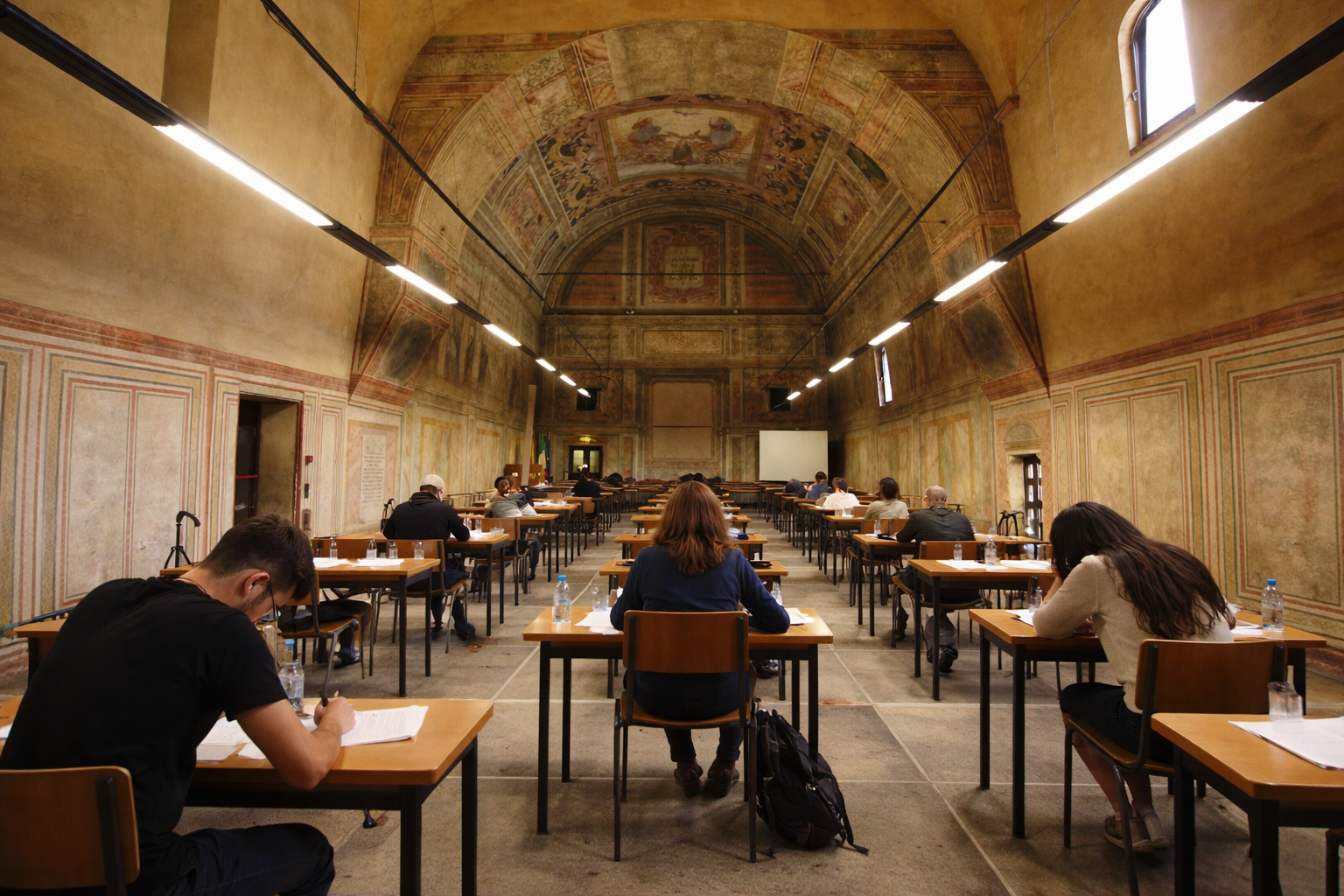
Exams are organized in three sessions:
- Winter (January-February) – 2 calls
- Summer (May-July) – 3 calls
- Fall (September) – 1 call
They can be taken only at the end of the series of lectures.
You can register for an exam 20 days prior to the exam up to 2 days before the actual exam date.
You can view the exams calendar at the following link
PLEASE SEE THIS PDF FILE for instructions on how to register for the exam and check /accept/refuse its result.
Internship
| Content | |
| Purpose | The internship aims at developing the student’s skills thanks to real work experience. |
| Compulsory status | The internship is not a compulsory activity within the MEDIP course synopsis. |
| Credits recognition | It is possible to replace one elective course of the II year (6 credits) with an internship (6 credits), or to include the internship as an extranumerary activity on top of the standard study plan, thus gaining extra credits. |
| Double Degree students | Both elective courses of the II year (6 + 6 credits) may be replaced by a single internship worth 12 credits only for Double Degree students, provided that the internship is included in the Learning Agreement. |
| Description and requirements | A 6 ECTS internship should: - be selected in the study plan during the second year (replacing one elective course); - be worth at least 400 hours of work and last at least 3 months; - be started and completed in the II semester of the II year; - be in line with MEDIP contents. |
| Transcript rules | As from 1st May 2024, 150 working hours will appear in the transcript as elective activity; remaining hours will appear as extranumerary. |
| How to find an internship | Almalaurea – https://www.almalaurea.it JOBTEASER – https://www.jobteaser.com C.O.R. – placement@unipv.it AIESEC – https://aiesec.org |
| Erasmus traineeship | Erasmus Traineeship (ITA) Erasmus Traineeship (ENG) Two calls per academic year. |
| Internships report | MEFI/MEDI/MEDIP students’ internships since 2017. |

The final thesis (worth 24 credits) is normally written during the second semester of the second year.
The thesis should present an original piece of theoretical or empirical work, or a complete review of the literature.
The subject area of the thesis is normally chosen by the student who will then agree the specific topic together with the thesis supervisor (relatore). It is advisable that the student should contact and make agreements with the supervisor in advance (normally during the first semester of the second year).
The thesis is normally divided into parts, and the parts into chapters. The chapters can be further divided into sections, normally numbered.
For further information check the following link: http://economiaweb.unipv.it/2018/12/14/laurearsi-magistrali/